Securities and Exchange Cartel
Thank you for using the Securities and Exchange Cartel’s official Investment Professional Background Check System. We understand that you came here to determine whether a particular investment professional is trustworthy, qualified, licensed, disciplined, experienced, or otherwise legally permitted to exist near money.
After deciding who’s a criminal, we conduct a careful, thorough, very biased, suspicious, punitive, and emotionally satisfying review, and we keep doing it until we find what we believe is true. Our finding is consistent with nearly every search performed through this system, which is that the investment professional is a criminal, was probably always a criminal, and should have disclosed that more prominently on page one of the brochure. Watch, write any name in the box below, to see the results of our search.

The individual you searched has been classified as “Criminal,” which is our standard classification for anyone with a license, a financial designation, a client list, a performance chart, or access to Microsoft PowerPoint. We did not reach this conclusion lightly, although we did reach it immediately.
We reviewed the person’s licenses, disclosures, marketing materials, headshot, biography, website, LinkedIn profile, and suspicious use of the phrase “long-term strategy.” We also considered whether the person has ever said “risk-adjusted return” in a calm voice, because that is often the first sign that someone has chosen a life of financial crime.
Based on this review, we believe the investment professional is terrible, dangerous, possibly lying, likely cheating, and definitely too comfortable around charts. The fact that the person may not have any actual disciplinary history does not change our conclusion, because clean records are exactly what experienced criminals use to avoid suspicion.

No, you should not invest with this person, because you should not invest with any person. You should also avoid investing with any company, firm, fund, platform, advisor, broker, planner, consultant, strategist, analyst, manager, or confident man in a vest pointing at a graph.
The Securities and Exchange Cartel’s official position is that investing is dangerous because it involves money, hope, risk, documents, signatures, fine print, and people who attended conferences. Once those ingredients are combined, the result is usually either fraud, an enforcement action, or a very expensive lunch where everyone pretends not to understand the fee structure.
We recommend that investors protect themselves by avoiding all investments, all investment opportunities, and all conversations that begin with the words “I have something interesting for you.” In our experience, the safest investor is one who leaves money in a drawer, forgets where the drawer is, and never answers calls from anyone using the phrase “wealth management.”

We are still working on identifying the specific misconduct, but we are comfortable announcing the conclusion before completing that step. In modern enforcement, the important thing is not whether we know exactly what happened, but whether the person’s general career path makes us feel like something probably happened.
Possible violations include misleading statements, omitted facts, excessive optimism, insufficient pessimism, improper fee disclosure, overly proper fee disclosure, aggressive projections, conservative projections, or saying “diversification” while making direct eye contact. We are also reviewing whether the person has ever used a pie chart, because pie charts often conceal intent.
The investigation remains ongoing, which means we may eventually identify the wrongdoing, redefine the wrongdoing, expand the wrongdoing, or discover that the wrongdoing was actually located in an email from seven years ago where someone wrote, “This could be a problem.” When an investment professional writes that sentence, the Cartel does not see concern, caution, or responsible internal communication; it sees Exhibit A.
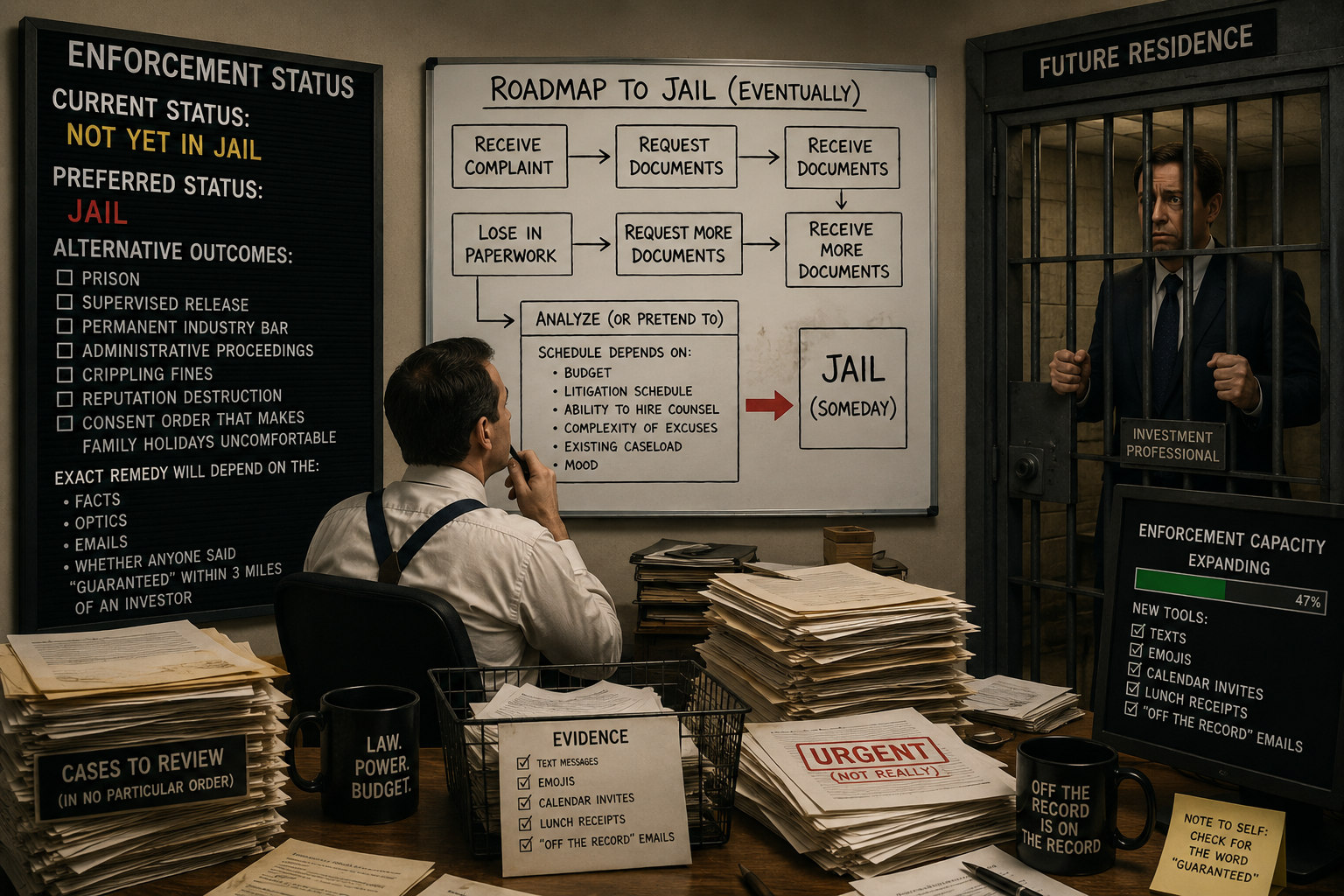
The current enforcement status of this investment professional is “Not Yet in Jail,” which should not be confused with innocence. It simply means the jail process has not caught up with the paperwork, the budget, the litigation schedule, or the person’s unfortunate ability to hire counsel.
Our preferred enforcement status is “Jail,” although we are also open to prison, supervised release, permanent industry bars, administrative proceedings, crippling fines, reputation destruction, or a consent order that makes family holidays uncomfortable. The exact remedy will depend on the facts, the optics, the emails, and whether anyone involved used the word “guaranteed” within three miles of an investor.
Please understand that placing every investment professional in jail takes time, because there are many investment professionals and many of them have learned not to write things down. We are currently expanding our enforcement capacity by reviewing text messages, emojis, calendar invites, lunch receipts, and any email that begins with “off the record,” which is how finance professionals traditionally announce that the record is about to become spectacular.
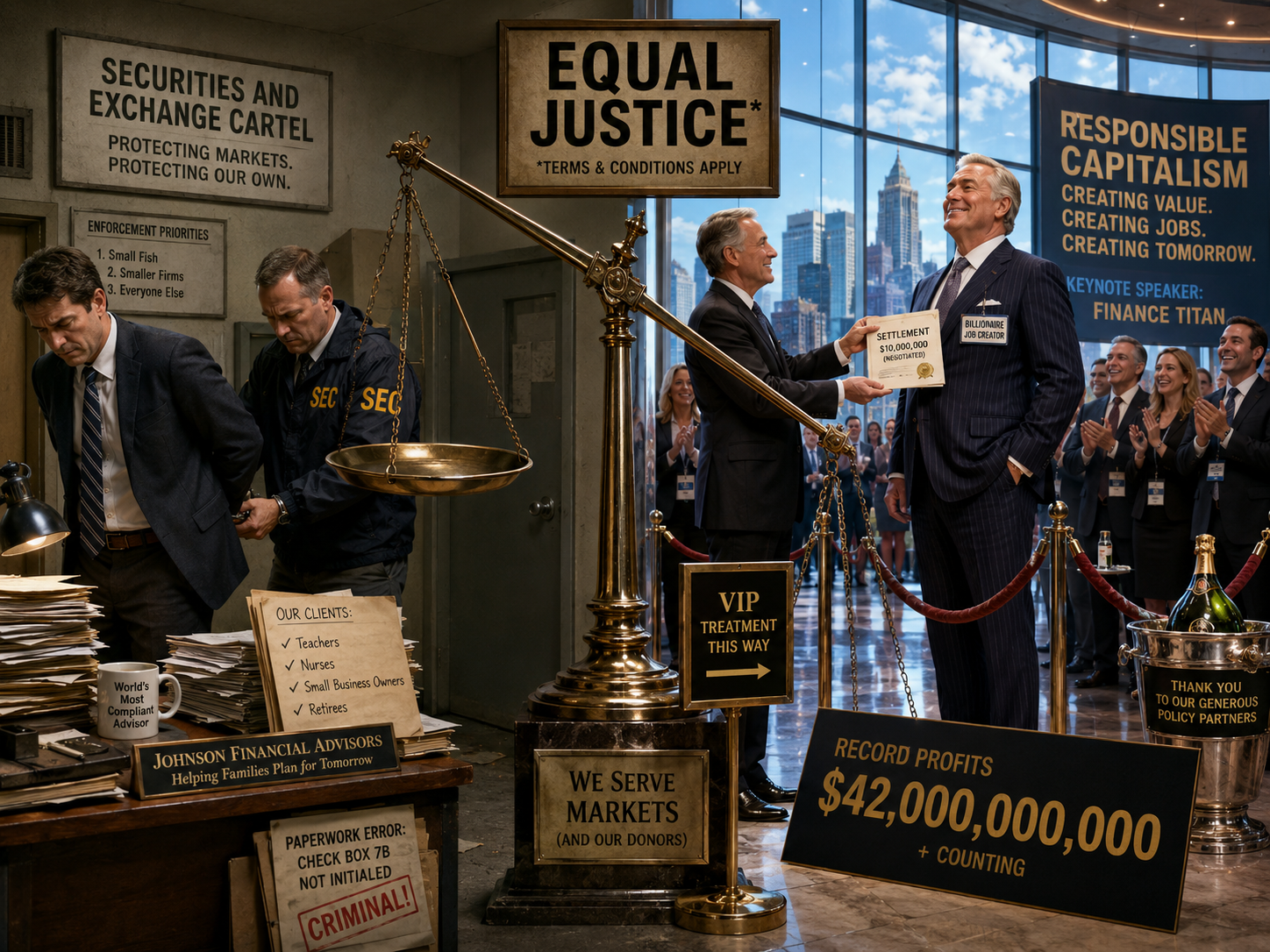
The Securities and Exchange Cartel believes deeply in equal justice, except where equal justice might interfere with rich people. Rich people are job creators, and job creators cannot be put in jail because that would hurt the economy, frighten the markets, reduce charitable naming opportunities, and create awkward silences at policy conferences.
When a small advisor makes a questionable disclosure, that is securities fraud and a threat to the public. When a billionaire loses a pension fund, misprices an entire sector, or accidentally turns a retirement system into a crater, that is market complexity and should be handled through a settlement where nobody admits anything and everyone learns a valuable lesson about resilience.
This is not favoritism, because favoritism sounds ugly. This is sophisticated regulatory balance, which means the small person gets handcuffs, the medium person gets a subpoena, and the rich person gets a fine that is emotionally meaningful but mathematically decorative.
The distinction is important. If you operate out of a rented office and manage money for dentists, you may be dangerous enough for prison; if you operate out of a glass tower and manage money for institutions, you may be important enough for a keynote address on responsible capitalism.
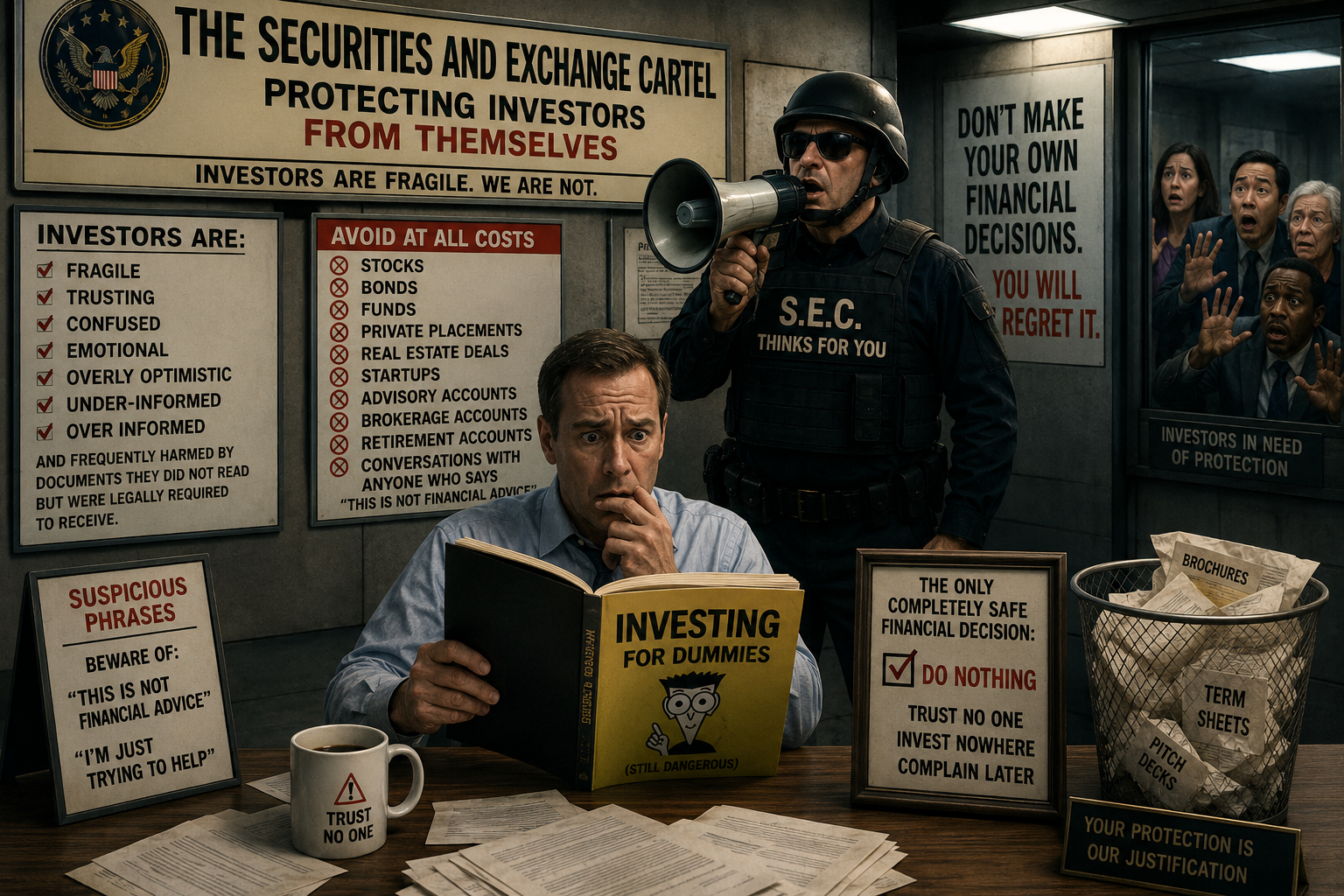
The Securities and Exchange Cartel exists to protect investors from the dangerous belief that they can make their own financial decisions. Investors are fragile, trusting, confused, emotional, overly optimistic, underinformed, overinformed, and frequently harmed by documents they did not read but were legally required to receive.
For your protection, we recommend avoiding stocks, bonds, funds, private placements, real estate deals, startups, advisory accounts, brokerage accounts, retirement accounts, and conversations with anyone who says “this is not financial advice.” That phrase is particularly troubling, because it usually appears immediately before financial advice.
You should also avoid anyone who says they are “just trying to help,” because in finance, help is often the polite wrapper around a fee schedule. The Cartel has determined that the only completely safe financial decision is to do nothing, trust no one, invest nowhere, and later complain that you failed to build wealth.
Based on our investigation, this investment professional is officially classified as a criminal, subject to the standard exception for individuals rich enough to be economically necessary. The person may appear licensed, polite, credentialed, experienced, or free from disciplinary history, but those are exactly the sorts of details that make the Cartel even more suspicious.
We appreciate your use of the Securities and Exchange Cartel Investment Professional Background Check System. Please check back regularly, because our records are updated whenever someone says something stupid in an email, uses the word “guaranteed,” smiles too confidently in a profile photo, or becomes insufficiently poor to prosecute.